
Summary
This analysis builds on a previous report, which analyzed the average total cost of ownership of a similar electric and gasoline vehicle. Since EV drivers in California generally experience a different cost of living than the country as a whole, including higher electricity prices on average and higher vehicle registration fees, we decided to analyze the total cost of vehicle ownership in this state specifically. The previous report details the assumptions made and sources used to estimate an average cost of ownership for an average driver in the US. This new analysis is specific to California, and the changes to assumptions and sources for this analysis are detailed here.
Changes from the previous analysis
The sales tax for vehicle purchase was modified from a national average to California’s average state and local tax rate (8.99%), according to the Tax Foundation. This calculation does not include the federal tax credit for electric vehicles. The analysis assumed a loan duration of 60 months, an interest rate of 10%, and a down payment of 20%. It also uses the annual average miles driven per year in California, which is 12,524 according to the Federal Highway Administration. The initial registration, title, and license fees, as well as the annual registration fees for both cars, were calculated from the state of California’s DMV calculator. AAA’s Your Driving Costs calculator was used to estimate the annual insurance and maintenance costs in California for both cars, assuming 15,000 miles driven annually, given the calculator’s limited parameters.
To calculate the charging cost for the EV, the analysis uses the average residential electricity rate for California in November 2025, according to the U.S. Energy Information Administration. For the base analysis, it was assumed that 88% of charging is done at home. For the second analysis, it was assumed that 0% of charging is done at home and 100% of charging is done in public. The average cost per kilowatt hour for public charging in California was sourced from AAA on January 29, 2026. This source provides the most comprehensive known data on public charging prices. However, it includes prices for Level 1, Level 2, and DC fast public charging, even though Level 1 and Level 2 are not generally the most popular public charging methods.
Therefore, this average price may be lower than the real-world prices that drivers pay most often. For the gas car, the average price of gasoline in California was also sourced from AAA on January 29, 2026.
Total cost of ownership data
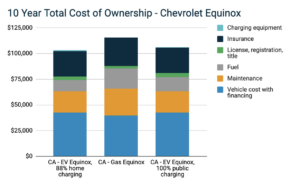
Below are the result tables and a summary chart showing the 7-year and 10-year cost of ownership for a gas and electric Chevrolet Equinox in California.

Results
While the total cost of ownership for both vehicles is higher in California than the national average, there is still a cost savings for driving an EV in California. An EV driver who mostly charges at home would save $12,417 over 10 years compared to a gas vehicle driver, and an EV driver who only charges in public would save $9,366 over 10 years. The gas car driver would pay more in fuel and maintenance costs, while the EV driver would pay more in insurance and registration fees. This analysis shows that driving an EV is not necessarily more expensive than driving a comparable gas vehicle in California.
Report completed in January 2026.