
Support CleanTechnica’s work through a Substack subscription or on Stripe.
Motorcycles are a really big deal in a lot of African countries, with most of them deployed as taxis. Close to 30 million motorcycles on the continent are used in this motorcycle taxi industry. With almost 99% of them still being internal combustion engine motorcycles, there is a huge opportunity and a large addressable market for electrification. The move towards electric vehicles in Africa, especially in this electric motorcycle sector, has mainly been driven by the private sector by small startup companies, and this requires an enormous amount of capital.
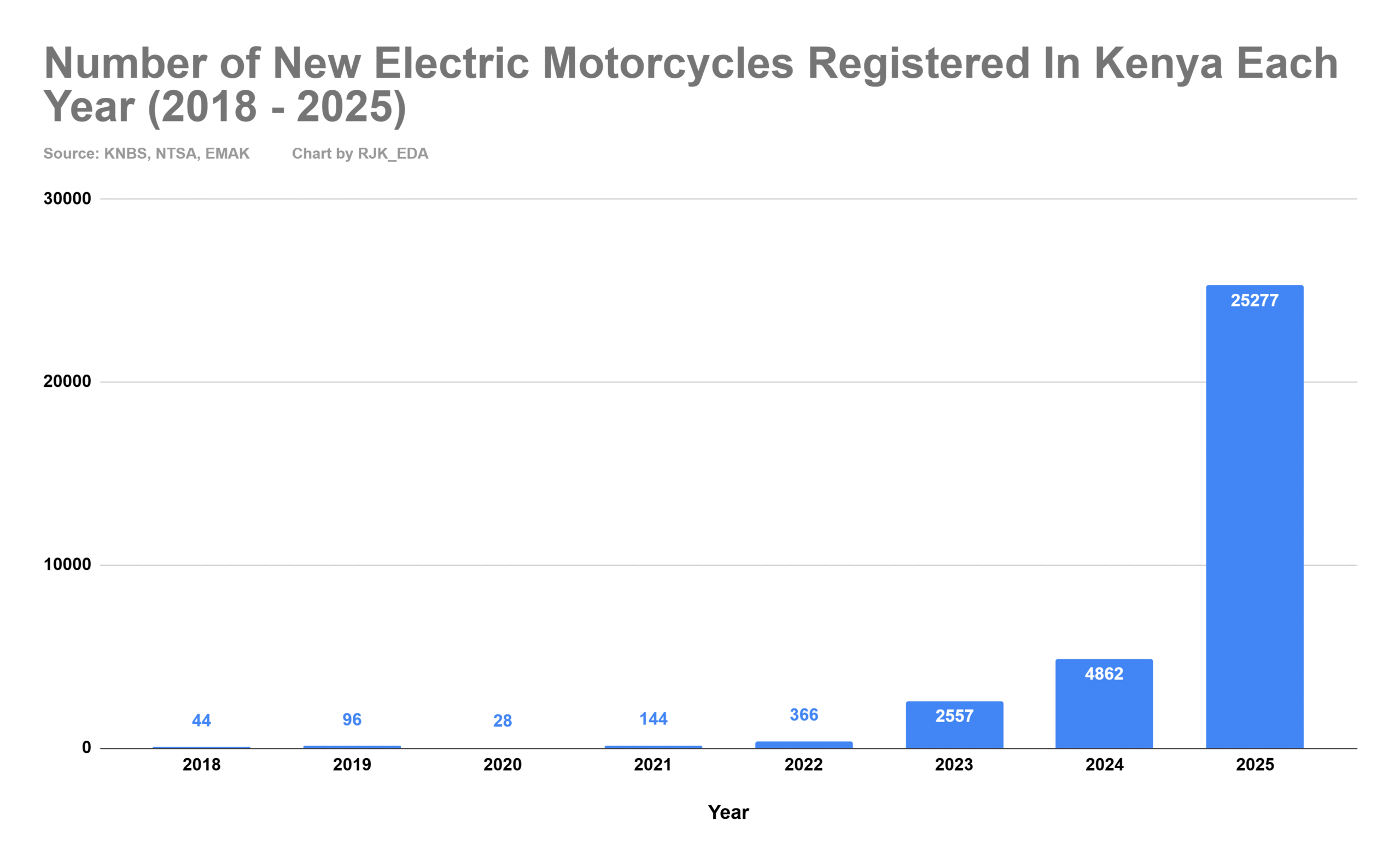
Let’s look at Kenya as an example and see just how rapid the rise of electric motorcycles has been and the effect on the overall ecosystem, resulting in the need for frequent capital injection to mitigate challenges associated with growth spurts. Registrations of electric motorcycles surged again in 2025 following a breakthrough year in 2024. In 2023, there were 70,691 motorcycles sold in Kenya in the overall market, and 2,557 of these were electric. That means 3.6% of motorcycles sold in 2023 in Kenya were electric. That is almost 4%. So, we did not expect it to be long before the market share reached the critical 5%, which is generally viewed as the tipping point indicating the start of mass adoption. The share of electric motorcycles had risen to 3.6% in 2023 from 2.8% in 2022 and 0.5% in 2021. 2024 was even better as the market share surged to 7.1%. The KNBS Economic Survey Report (2025) shows that 68,804 new motorcycles were registered in Kenya in 2024. Of these, 4,862 motorcycles were electric, according to data presented by the Electric Mobility Association of Kenya (EMAK). That is where the 7.1% market share comes from.
2025 was even better as the market share of electric motorcycles reached a whopping 15.3%. This is really awesome, especially given the fact that just about 8 years ago only 44 electric motorcycles were registered in the whole country! The overall motorcycle market was up 145% from 68,804 motorcycles in 2024 to 168,286 in 2025. With 25,277 of motorcycles registered in Kenya in 2025 being electric, it means 15.3% of all new motorcycle restorations in Kenya in 2025 were electric. How cool is that! With over 2 million internal combustion engine motorcycles registered in Kenya, the opportunity to electrify the sector is massive. Of the 25,277 electric motorcycles sold in Kenya in 2025, over 15,000 of them were from Spiro. That means Spiro had a 60% share of the new electric motorcycle sales market in Kenya in 2025! Spiro now also has a network of over 400 battery swap stations in Kenya.
Let’s look at the rapid rise of electric motorcycle sales in Kenya again using the chart below as an example:
This rapid ramp-up can lead to unique challenges in the ecosystem. One of them that has emerged is a rapid rise in demand for batteries at swap centers as the number of motorcycles on the market grows. This is to be expected in such a scaled-up environment. Tom Courtright summarizes this issue quite well. Tom says simply put, this could be due to a mismatch between supply of batteries and demand from drivers at a given time. Drivers only notice this in a supply shortfall; if there’s excess batteries on the network, it’s more capital needed by the battery network, but that’s a boon for drivers. So how does a battery shortfall happen? In general, there could be several possibilities:
- Some batteries may run down faster than expected, taking batteries off network or reducing their capacity. This can happen especially in early stage pilots as companies put products in real life use cases and iterate from there. This will generally be ironed progressively out as companies identify issues and solve them as they iterate and scale.
- Too many motorcycles deployed ahead of battery deployment, knocking the companies’ ratio off
- Battery import delays — most commonly during shipping or receiving customs. This is a common issue in Kenya.
Tom adds that in general, these are growing pains. Larger networks will be more stable; logistics kinks worked out; and (hopefully) more financially stable.
Companies can also work this out using real swap station data, identifying which areas are the areas seeing increasing demand in real time, and then allocating assets accordingly.
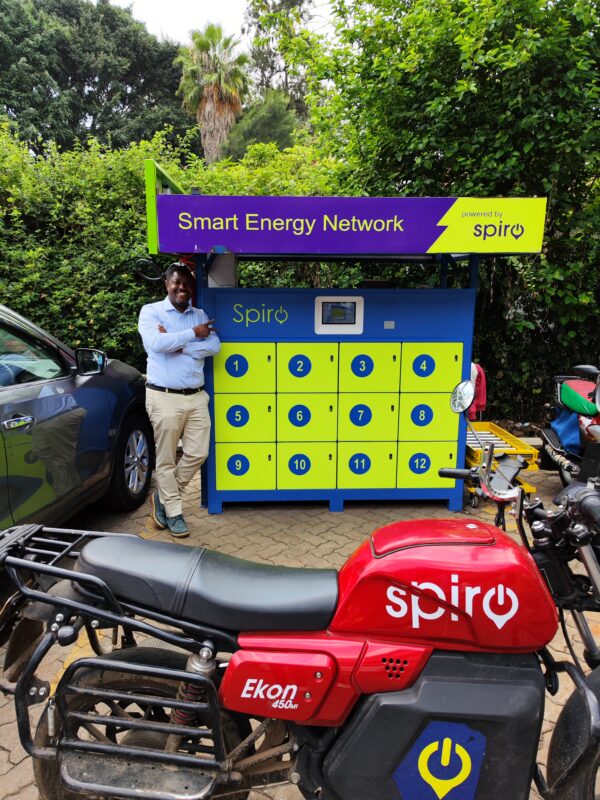
As the largest player in the market, and on the African continent, Spiro is constantly mobilizing capital to accelerate their rollout while simultaneously working to mitigate any associated demand driven ecosystem challenges along other contributing factors such as electrical connection wait times for battery swap sites due to lead times for electricity meters from the utility company or from finding appropriate locations to host swap centers, and in many cases, workflows facilitating necessary upgrades to the preferred sites’ capacity.
As part of Spiro’s continued push to scale electric mobility adoption across the continent, it just announced the raising of $50 million in debt funding from Afreximbank and two new investors, Nithio and Africa Go Green Fund, managed by Cygnum Capital. The new funding follows Spiro’s landmark $100 million investment in October 2025, which became Africa’s largest-ever electric mobility investment. That means Spiro has raised $150 million recently and well over $200 million including previous rounds. Spiro says the new capital will support the continued expansion of its battery-swapping network across existing and new markets, while further advancing the company’s proprietary technology platform, including automated battery swaps, fast charging, and renewable energy integration.
Spiro currently has 80,000 electric motorcycles, over 2500 battery swapping stations, circulated over 300,000 batteries, and has completed more than 30 million battery swaps to date, Spiro has achieved over one billion kilometers of low-carbon emissions travel, transforming mobility and economies through substituting expensive imported fossil fuel-based transportation. Spiro is operational in six countries — Kenya, Uganda, Rwanda, Nigeria, Benin, and Togo — with pilots underway in Cameroon and Tanzania.
“Demand for Spiro’s innovative, industry-leading battery swapping infrastructure continues to grow and is reshaping mobility in Africa by providing reliable, clean transportation options across the continent,” said Kaushik Burman, CEO of Spiro. “With strong financial backing and cutting-edge technology, Spiro is leading Africa’s transition to sustainable mobility. This new funding reinforces our vision of building a robust, scalable energy network tailored for Africa by Africans.”
“Spiro’s growth exemplifies the power of Made-in-Africa, for-Africa solutions,” said Gagan Gupta, Founder of Spiro. “By combining local insights with global best practices, we are creating a resilient, green energy ecosystem that supports economic development and climate goals. This funding empowers us to bring affordable clean energy and mobility to millions of Africans while deploying an industry leading energy infrastructure that will contribute meaningfully to a greener future in Africa.”
“Spiro has built a strong platform that is delivering tangible impact across multiple African markets; we are pleased to support the next phase of its growth as it scales critical clean mobility infrastructure,’’ said Laurène Aigrain, Managing Director of Africa Go Green Fund. “This transaction reflects our commitment to backing commercially robust businesses that combine innovation with measurable environmental and social impact.”
“Spiro is one of the largest and fastest-growing players in the pan-African e-mobility market,” said Raghav Sachdeva, CIO of Nithio. “They have demonstrated that electric mobility can scale rapidly while delivering real economic value to riders and meaningful emissions reductions. We are proud to support Spiro’s continued growth and see e-mobility as a critical pillar of Africa’s clean energy transition.”
“Driving Africa’s transition to electric mobility is central to how we view sustainable economic development across the continent,” said Oluranti Doherty, MD, Export Development at Afreximbank. “By supporting Spiro, Afreximbank is committed to financing the future of sustainable African trade; we are promoting a green industrial value chain that keeps innovation at the forefront of a just energy transition.”
As discussed before, the uptake of electric vehicles in several countries, especially in the electric motorcycle sector, is growing at a much faster rate than most people had thought. With these kinds of investments, 2026 promises to be an even bigger year for electric vehicles, especially electric motorcycles in a number of African countries.
Images by Remeredzai
Sign up for CleanTechnica’s Weekly Substack for Zach and Scott’s in-depth analyses and high level summaries, sign up for our daily newsletter, and follow us on Google News!
Have a tip for CleanTechnica? Want to advertise? Want to suggest a guest for our CleanTech Talk podcast? Contact us here.
Sign up for our daily newsletter for 15 new cleantech stories a day. Or sign up for our weekly one on top stories of the week if daily is too frequent.
CleanTechnica uses affiliate links. See our policy here.
CleanTechnica’s Comment Policy