
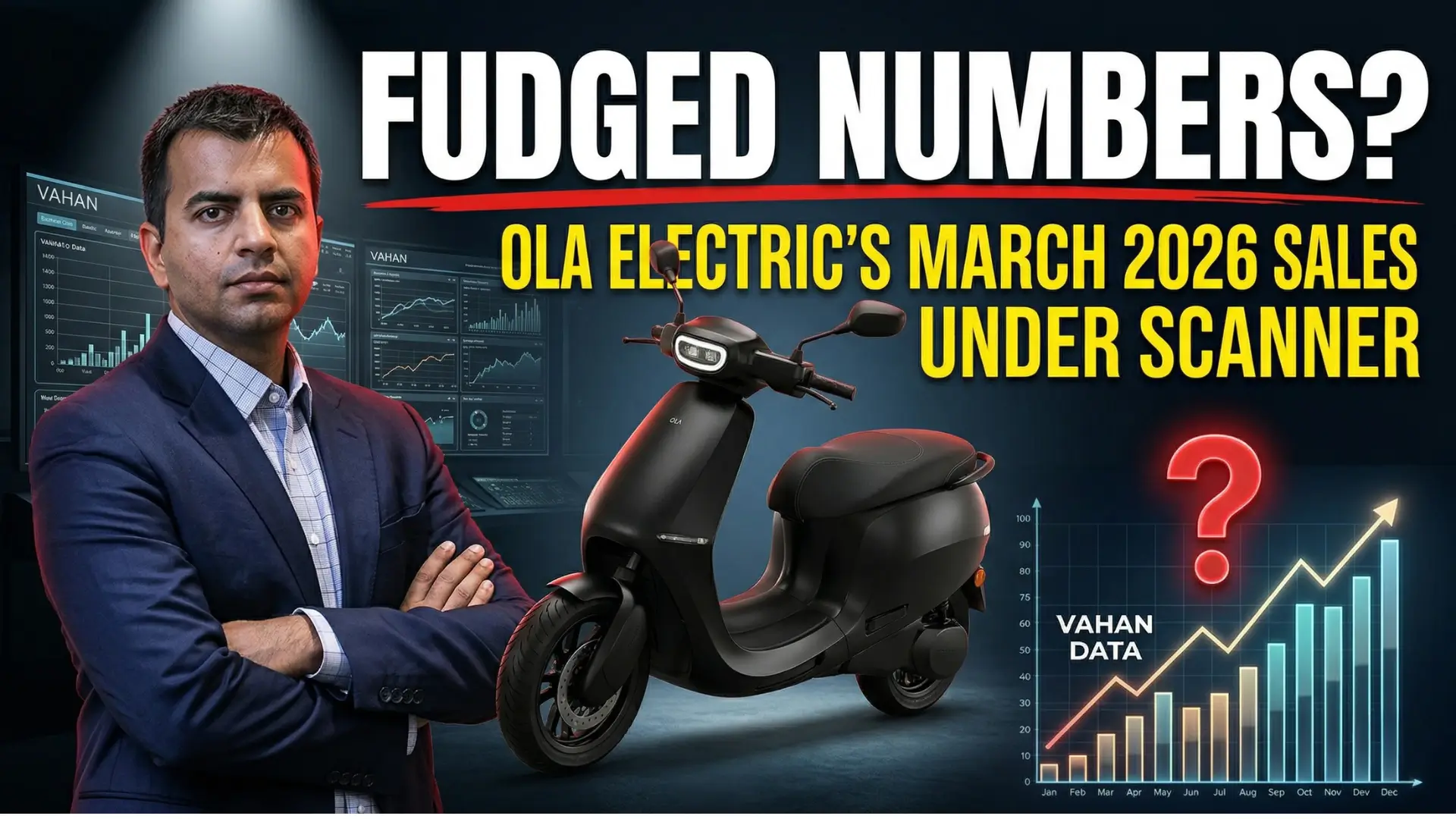
Recently, I came across a reel by @marketswithjayant – a popular finance and markets influencer on Instagram, and it stopped me mid-scroll.
He was calling out Ola Electric directly, saying that Bhavish Aggarwal’s March 2026 “comeback” numbers are being inflated by counting warranty replacements and upgrade swaps as fresh new sales on VAHAN.
His exact words: “Fraud Ola Electric founder is now fudging numbers, only Bhavish could do this.”
Strong words. But once I started digging into the actual data, I realised the question he’s raising is completely legitimate — and nobody in the mainstream automotive media seems to be asking it seriously.
So let me try to lay it out clearly.
Truth Behind Ola Electric’s “150% Growth”
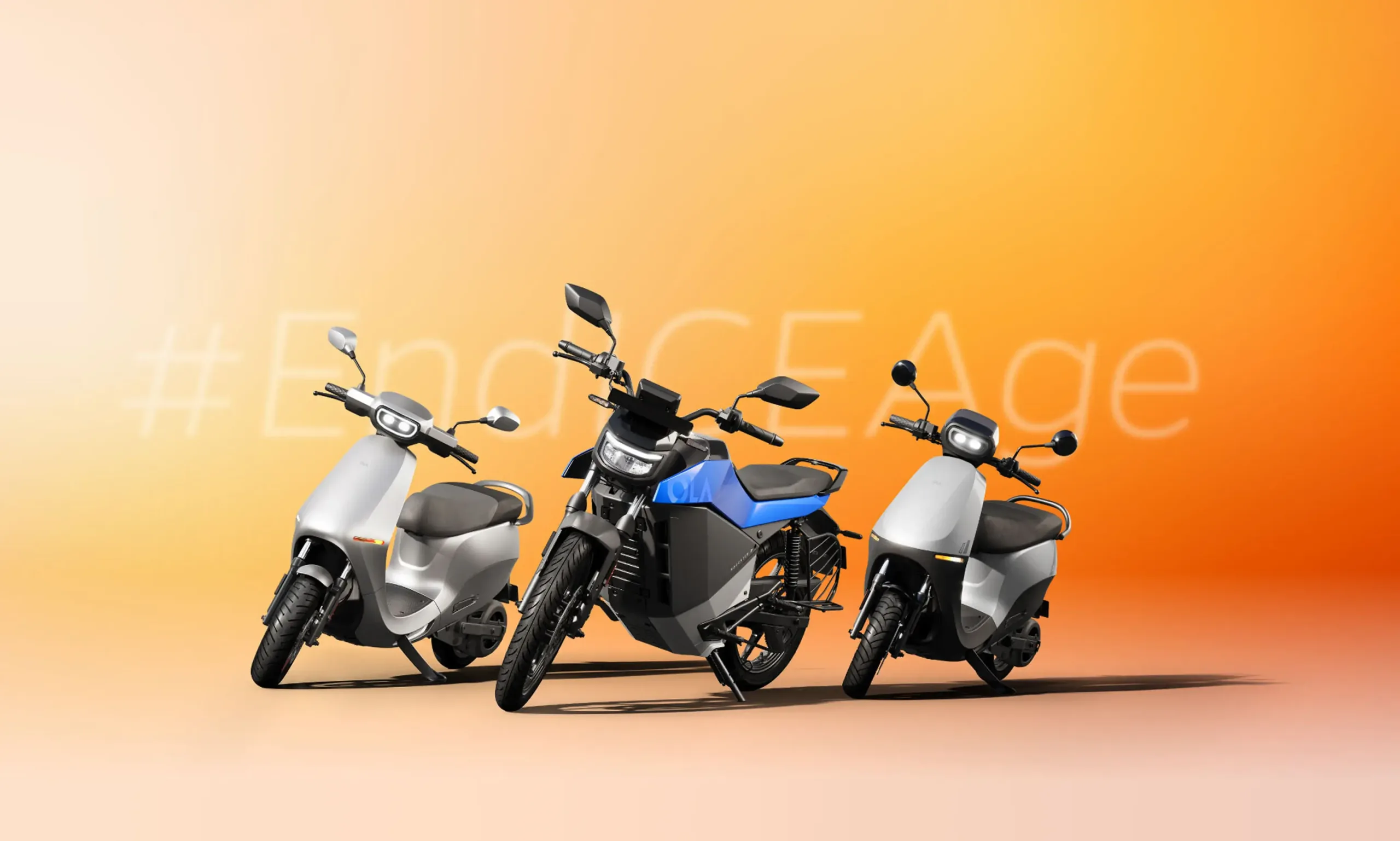
On April 1, 2026 — yes, April Fools’ Day — Ola Electric filed a press release with NSE and BSE claiming 10,117 unit registrations in March 2026, up from 3,973 units in February, translating to over 150% month-on-month growth.
The filing was signed by CFO Deepak Rastogi as per Autocar Professional.
The company called it a “sharp V-shaped market share recovery.” Ola Electric’s spokesperson said: “We are seeing a clear inflexion in demand, with daily orders scaling steadily through March and accelerating meaningfully in the final weeks.”
The stock market loved it. Shares of Ola Electric surged 9.07% to ₹24.89 as investors responded positively to the recovery numbers.
Great story. But let’s actually look at this carefully.
Most of the “Growth” Happened in the Last 5 Days
Towards the end of March, Ola Electric launched a campaign offering discounts of up to ₹50,000 across its portfolio, with some variants priced as low as ₹49,999.
The campaign ran from March 26 to March 31 as per Inc42 Media.
So Ola ran an aggressive, last-minute fire sale for literally the final 5 days of the month — and then announced a 150% month-on-month recovery.
That’s not organic demand recovery. That’s a month-end push dressed up as a turnaround.
Think about it. If your base was 3,973 in February, already the worst month in years, even a desperate end-of-month discount blitz can create a 150% jump on paper.
The Replacement-as-Registration Problem
This is the core of what marketswithjayant is pointing out, and I think he’s onto something important.
Here’s how VAHAN works: every time a vehicle gets a new chassis number, it gets a new registration entry.
Period. VAHAN does not distinguish between a brand-new customer purchase and a replacement unit handed to an existing customer under warranty.
Ola Electric has been dealing with a massive service and quality crisis.
The Central Consumer Protection Authority received over 10,000 complaints against Ola Electric in a single year, ranging from consumer rights violations and misleading ads to refund disputes and persistent service failures.
Many of these customers received faulty scooters. When Ola replaces a defective unit under warranty, which requires issuing a new vehicle with a new chassis number, that replacement gets a fresh VAHAN registration.
It counts as a new sale in the data. But it is not a new customer. It is not new revenue. It is just Ola fixing its own quality mess.
Similarly, Ola has been aggressively pushing upgrade schemes, encouraging existing S1 customers to swap their older scooters for a newer Gen 3 model. Each of those swaps also generates a new registration.
Nobody knows exactly how many of the 10,117 March registrations are genuine new customers versus replacements and upgrades. Ola hasn’t disclosed this. And that is the problem.
These Sales Numbers Tell a Different Story
Let me put March 2026 in an honest context:
| Period | Ola VAHAN Registrations | Market Position |
|---|---|---|
| CY 2024 | 4,07,701 units | #1 in India |
| CY 2025 | 1,96,767 units | Lost #1 to TVS |
| Feb 2026 | 3,973 units | Below even Greaves/Ampere |
| Mar 2026 | 10,117 units | “V-shaped recovery” |
| Q3 FY26 Revenue | ₹470 crore | Down 55% YoY |
| Q3 FY26 Net Loss | ₹487 crore | Still deeply in the red |
A single month of improved registrations does not address these underlying financial challenges.
Ola Electric reported a net loss of ₹487 crore in Q3 FY26 alongside a 55% year-over-year revenue decline, with operating cash flow staying negative.
So even if you take the 10,117 number at full face value, which I am arguing you shouldn’t, it still barely puts Ola back at #5 in the market.
TVS is selling nearly 3x that number every single month without fire sales or last-minute discount campaigns. Read more here on India’s Electric Two-Wheeler Sales – March 2026.
This Is a Pattern, Not an Isolated Incident
I want to be very clear: this is not the first time Ola’s numbers have raised serious questions.
In February 2025, Ola counted yet-to-be-launched Roadster X motorcycle bookings and undelivered Gen 3 scooter orders in its sales figures, calling them “confirmed orders” Together, these two categories accounted for approximately 50% of the claimed 25,207 February 2025 sales figure. Outlook Business
The government wasn’t amused.
The Heavy Industries Ministry directed ARAI to probe the mismatch between Ola’s reported sales and actual VAHAN registrations, and asked them to submit a report within 15 days.
Since April 2025, Ola Electric has changed its stance on gigafactory capacity, monthly break-even sales figures, revenue guidance, and distribution network strength, all within months of each other.
Analysts noted that statements not backed by business logic can be construed as misleading investors.
This is a company with a documented, repeated history of presenting optimistic numbers that don’t hold up to scrutiny.
That context matters enormously when evaluating March 2026’s “150% growth.”
What Ola Should Disclose, But It Hasn’t
If Ola Electric genuinely wants investors and customers to trust its recovery story, here is what it needs to answer publicly:
- Of the 10,117 March registrations — how many are first-time buyers vs. warranty replacements?
- How many are upgrade swaps from existing customers under Ola’s exchange programs?
- How many of the “1,000 daily orders in the last week” were driven purely by the ₹49,999 fire sale discount?
- What is the net revenue per unit after the ₹50,000 discount? Is Ola selling below cost?
Until these questions are answered, the 150% growth headline is, at best, a misleading context and at worst, exactly what Jayant is calling it.
Is There Any Real Recovery?
I want to be balanced here. I don’t think the entire March number is fake.
There probably is some genuine demand for the service improvements that appear real, the same-day service claims are being independently verified by some customers, and the ₹60,000 price cut on the Roadster X is a legitimate move that will bring in new buyers.
But a company that has lost 50%+ of its annual sales volume in one year, whose stock has crashed from ₹100+ to under ₹25, whose auditors flagged material weaknesses in inventory controls, and which has a long track record of presenting numbers generously that company does not get to claim a “V-shaped recovery” based on one month of data without someone asking hard questions.
marketswithjayant asked that question on Instagram. I think it deserved a longer answer.
Final Word
Ola Electric as a company still has real technology, real ambition, and real infrastructure.
The Bharat Cell, the Gigafactory, and the Roadster are genuine achievements.
But a great product story and a manipulated sales narrative can coexist, and right now, the numbers deserve independent scrutiny that they are simply not getting from the mainstream media.
If Bhavish Aggarwal wants the market to believe in the comeback, he needs to show us the clean numbers, not just the headline figure.
Disclaimer: Sales figures are sourced from publicly available VAHAN data and Ola Electric’s official filings with the stock exchanges. This article was inspired by a reel shared by Instagram finance influencer @marketswithjayant. Views are independent and do not constitute financial or investment advice.