
In the early hours of Wednesday, March 19, a massive fire broke out at a three-storey house in Brajeshwari Annex Colony, near Bengali Square in Indore. Twelve members of a family were sleeping inside.
By morning, eight of them were dead, including two small children, three women, and three men. Three people survived.
The victims have been named as Tanmay (6), Rashi Sethia (12), Simran (30), Tinu (35), Suman Sethia (60), Vijay Sethia (65), Chhotu Sethia (22), and Manoj Pugalia (65). Simran was reportedly pregnant. Six of the victims had come from Bihar’s Kishanganj district to visit relatives at this house.
What Happened That Night?
The fire started between 3:30 AM and 4:30 AM, when the entire family was deep asleep. Within minutes, the blaze spread through all three floors of the building.
More than ten LPG cylinders stored inside the house exploded one after another, making it nearly impossible to escape.
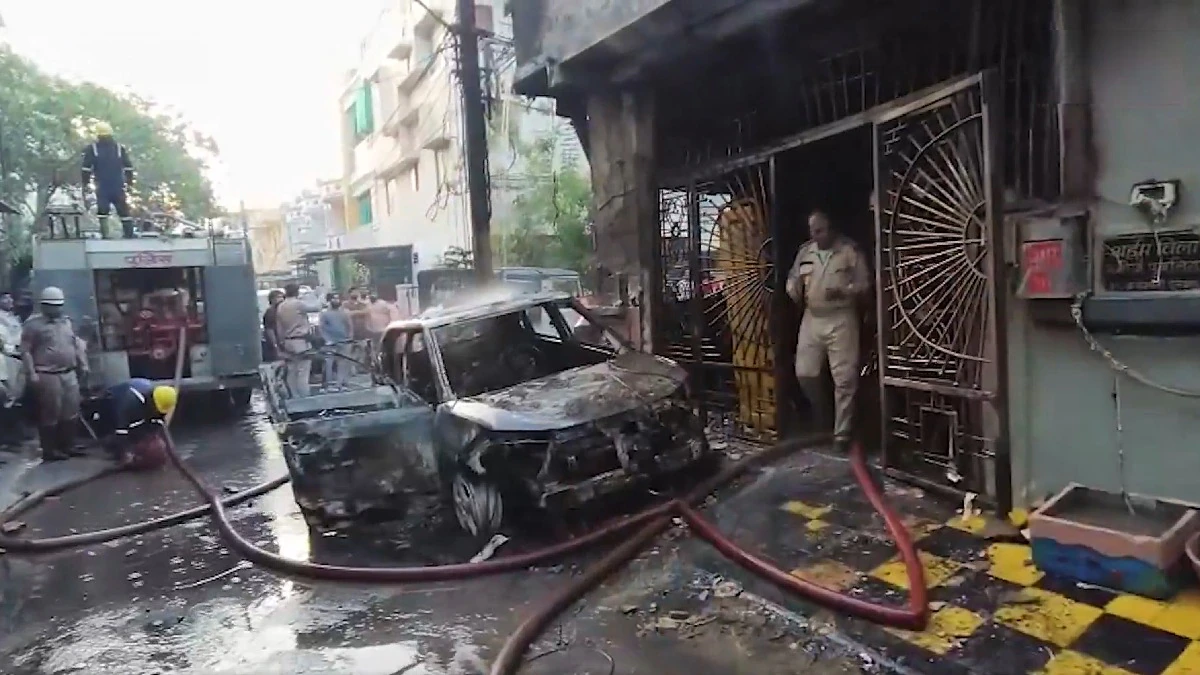
The owner, Manoj Pugalia, was a polymer trader; investigators believe flammable chemicals from his business, stored in the house, may have made the fire spread even faster.
Many residents nearby were woken up by the loud blasts. By the time fire tenders arrived, the building was already heavily engulfed. Narrow roads in the colony made it difficult for emergency vehicles to reach quickly.
Key Facts at a Glance
- Location: Brajeshwari Annex Colony, Bengali Square, Indore
- Time: Between 3:30 AM and 4:30 AM, March 19, 2026
- Deaths: 8 (2 children, 3 women, 3 men)
- Survivors: 3 rescued alive
- LPG Cylinders: 10+ stored inside, at least 4 exploded
- Vehicle: Suspected Tata Punch EV (not officially confirmed)
What Did Police Say?
Indore Police Commissioner Santosh Kumar Singh told the media that the fire started due to a short circuit at the EV charging point. According to him, the electric car parked outside was being charged overnight, and the charging point developed a fault that triggered the fire.
From there, it spread to the house wiring, a nearby sports bike, and quickly into the building itself.
This became the main story. News channels and social media pages — including several EV-focused communities — widely shared this version. Many people started questioning the safety of home EV charging in India.
But the Son Says Something Else Entirely
“The cause of the accident was not the car, but an electric pole. The car was not charging at all. The charger was not even connected.”
— Saurabh Pugalia, survivor and son of deceased owner Manoj Pugalia
Saurabh Pugalia, who survived and is the son of the deceased owner, directly questioned the police version. He said the car was simply parked; it was not plugged in or charging.
He pointed to a video circulating on social media that allegedly shows an explosion happening at a nearby utility pole, which then caused fire to fall on the parked car below.
He also cleared up another widely reported claim — that electronic door locks had malfunctioned during the power cut and trapped residents inside. “There is only a CCTV camera in our house.
There was an iron door, which was locked and got heated due to the fire,” he said. His father had tried to open a wooden door but was immediately overcome by the rushing flames.
Two Very Different Versions
| Point | Police Version | Survivor’s Version |
|---|---|---|
| The fire started from | EV charging point short circuit | Electric utility pole explosion |
| Was the car charging? | Yes | No — charger not connected |
| Door locks | Electronic locks failed in a power cut | No e-locks; an iron door heated by fire |
| Evidence cited | On-site inspection | Social media video of pole explosion |
What Is the Government Doing?
Chief Minister Mohan Yadav visited the Pugalia family and heard Saurabh’s account directly. He has ordered a detailed probe by an expert committee. The MP government has also said it will prepare a Standard Operating Procedure (SOP) for EV charging in residential areas.
Prime Minister Narendra Modi expressed condolences and announced an ex gratia of ₹2 lakh for each deceased and ₹50,000 for the injured.
What Must the Investigation Find Out?
For this case to be properly resolved, investigators must answer a few very specific questions: Was the car actually connected to a charger that night? What does the CCTV footage show?
Is there damage to the nearby electricity pole consistent with an explosion? And what exactly are the flammable materials found in the debris?
Until these questions are answered with evidence, it would be unfair — to the victims, to EV owners, and to the public — to fix the blame on any one cause.