
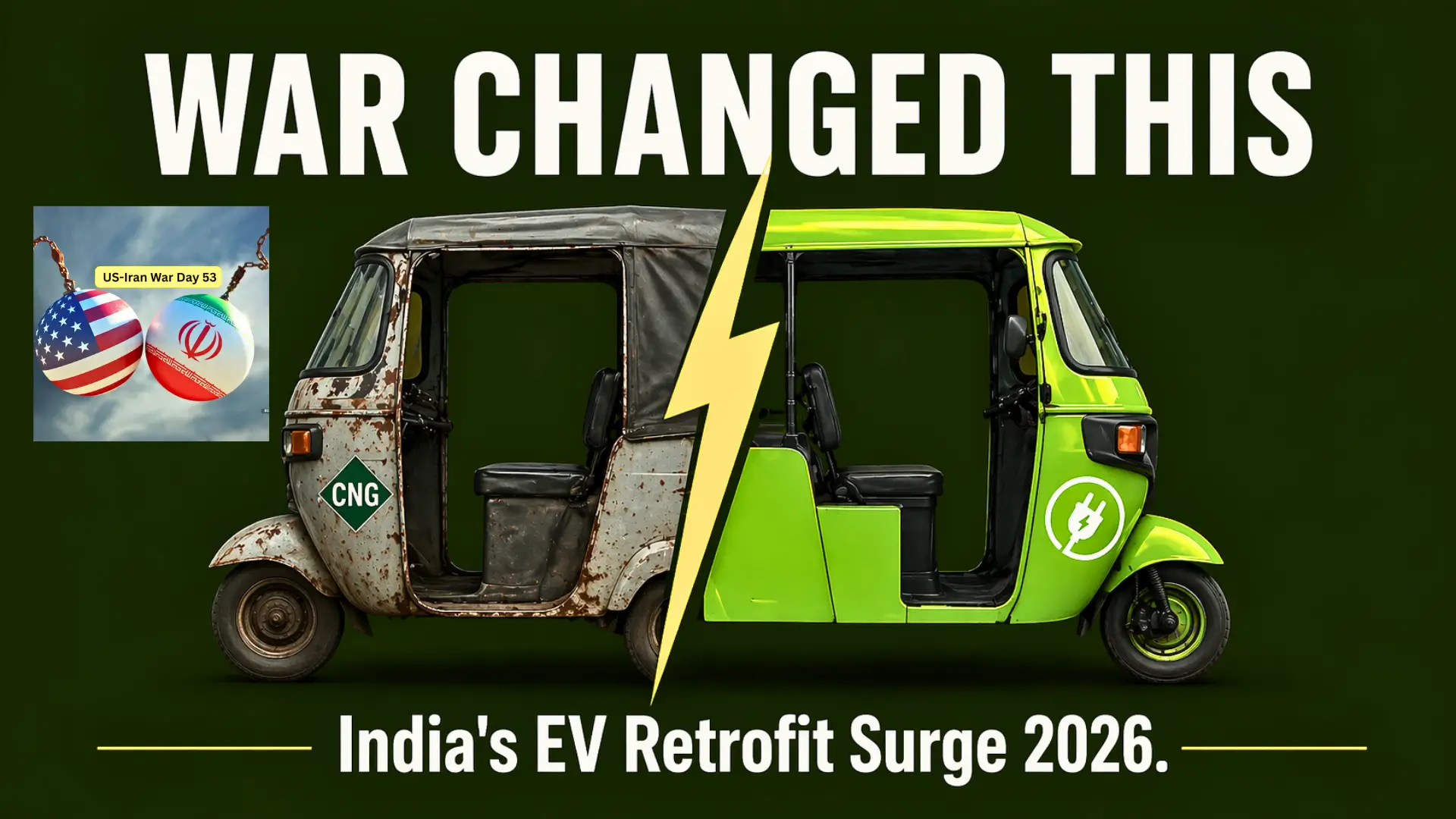
On February 28, 2026, Iran closed the Strait of Hormuz. The closure disrupted 20% of global oil supplies and significant volumes of liquefied natural gas, with analysts forecasting prices could reach $100 per barrel if disruptions persisted, as per the CNBC Report.
For India, the consequences were immediate and severe. India imports nearly 85% of its crude oil, and a large share of it passes through that very strait.
Within weeks, something unexpected started happening in workshops across Bengaluru and Gurugram.
Vehicle owners, auto-rickshaw drivers, cab operators, and small fleet owners began calling up a new breed of company asking a very specific question: how quickly can you convert my vehicle to electric?
Bengaluru-based Exponent Energy and Gurugram-based Folks Motor are two of the most active players in India’s fledgling EV retrofit space. Both companies report that inquiries have more than doubled since the war began, and the conversion is moving from inquiry to actual vehicle.
Folks Motor, which converts internal combustion engine cars to hybrids, was doing 40–60 vehicles a month before the conflict began. Since the West Asia war started on February 28, the firm has completed conversions on over 250 units.
That is a near 5x jump in output in under two months.
“We observed a clear and measurable uptick in consumer interest in vehicle retrofitting in the wake of ongoing geopolitical developments in West Asia,” said Nikhil Khurana, managing director at Folks Motor. “Customer queries for the technology switch have more than doubled compared to previous months.”
Exponent Energy focuses on the three-wheeler segment, specifically converting LPG and CNG auto-rickshaws to full electric.
Their pitch is direct: “If you own an LPG or CNG vehicle in the three-wheeler space, you can just come in and overnight be converted to electric,” said Arun Vinayak, CEO and founder of Exponent Energy.
The company launched as a pilot in Bengaluru and is now seeing sharp demand from drivers who run on gas — a fuel that has become both expensive and unpredictable. You can check out India’s top 10 Electric Car Conversion Companies here.
Why Did the War Hit India’s Fuel Supply So Hard?
To understand the retrofit surge, you need to understand just how exposed India is to this specific conflict.
The sharp decline in crude oil shipments through the Strait of Hormuz has triggered a supply shock that extends beyond short-term price volatility.
The crisis forced India to scramble for oil from wherever available, and the depreciation of the rupee by nearly 10% this financial year has not helped India’s cause as far as procuring oil is concerned.
The CNG and LPG situation is arguably worse than petrol and diesel.
Qatar is India’s primary LNG supplier and was directly hit. QatarEnergy announced on March 3 that it was declaring Force Majeure on its contracts with buyers, and internal sources said it would soon be shutting down gas liquefaction, as LNG tankers could not leave the Gulf.
For the lakhs of CNG auto drivers and LPG commercial vehicle operators in India, this wasn’t an abstract geopolitical event. It was their fuel supply and their livelihood under direct threat.
As of March 2026, the cost of the Indian Crude Oil Basket had gone up by about 133% compared to January levels.
While the government has held petrol and diesel retail prices steady at public sector pumps, private fuel retailer Nayara Energy hiked normal-grade petrol and diesel prices by up to ₹5 per litre effective from March 26, 2026.
And OMCs are now absorbing losses, facing a loss of about ₹13.50 per litre on the retail sale of diesel and ₹1 per litre on petrol.
That situation cannot hold indefinitely.
How much does EV Retrofit Actually Cost?
This is where it gets practically useful for anyone considering this route.
| Vehicle Type | Retrofit Cost | Comparable New EV Premium |
|---|---|---|
| Car → Hybrid | ₹3 – 6 lakh | New EV costs ₹2–4 lakh more than the ICE equivalent |
| CNG/LPG 3-Wheeler – Full EV | ~₹1.7 lakh | Significantly cheaper than a new electric 3-wheeler |
| ICE Car – Full EV | ₹4 – 8 lakh (estimated) | Depends on battery size and vehicle age |
The economics are straightforward for commercial operators.
A CNG auto driver spending ₹300–400 per day on gas can convert to electric for ₹1.7 lakh and bring running costs down to ₹40–60 per day on electricity.
At that saving rate, the retrofit pays for itself in under 8 months.
For car owners, the hybrid route at ₹3–6 lakh is more nuanced.
You are not eliminating fuel dependency; you are reducing it.
But in a market where fuel prices are volatile and rising, even a 30–40% reduction in fuel consumption has meaningful value.
You can understand in detail about What is EV Retrofit Technology? Conversion Kit, Cost & Top Companies in India.
3 Primary Policy Gap: Why Are Retrofits Still Niche?
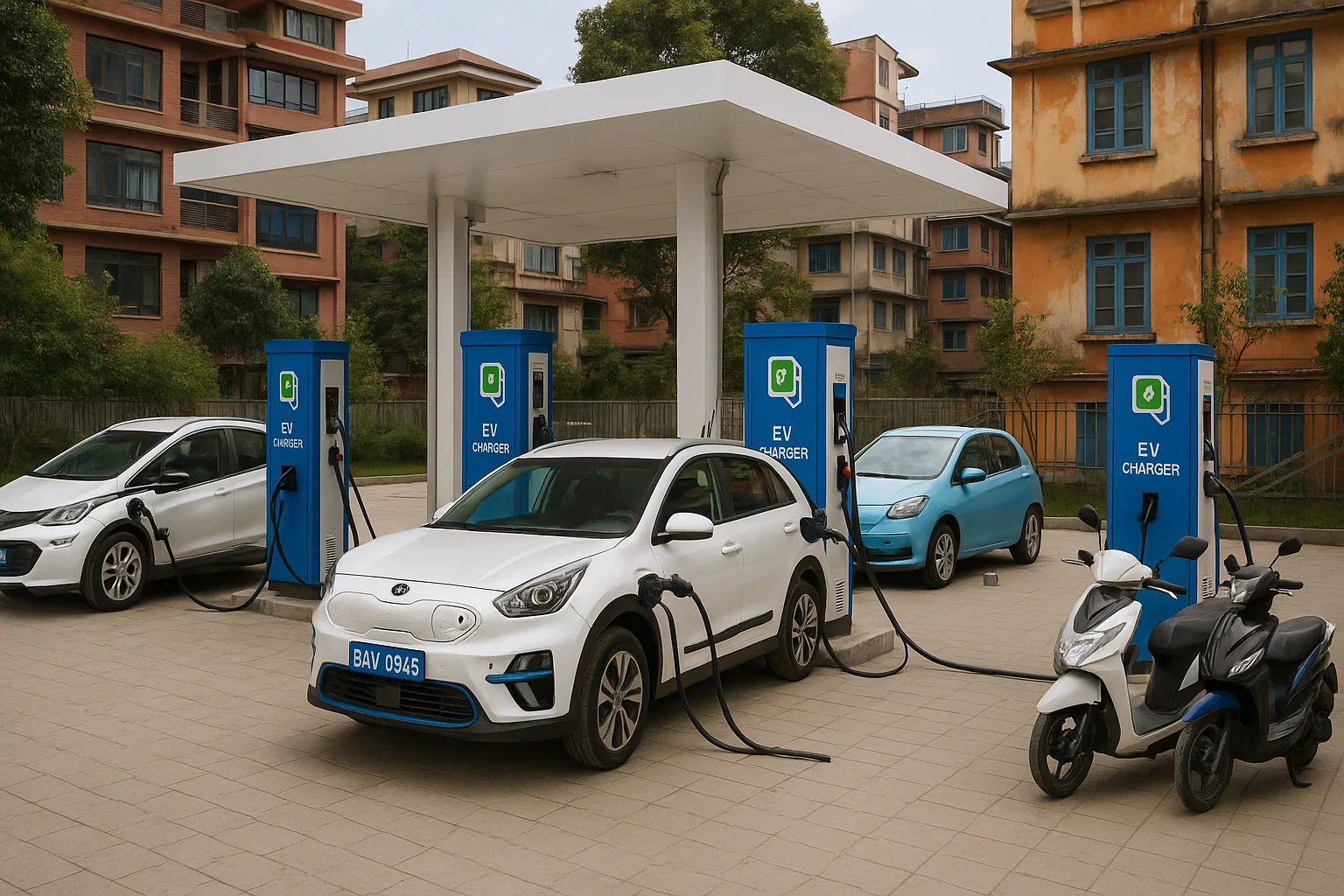
Despite the demand surge, EV retrofitting remains a very small segment in India. The reasons are structural.
The first hurdle is certification.
In India, every retrofit vehicle needs approval from the Automotive Research Association of India (ARAI), a technically rigorous and time-consuming process that most small retrofit operators struggle to navigate.
Without ARAI certification, the converted vehicle cannot be legally registered or insured.
The second hurdle is policy.
Delhi’s EV Policy 2.0 initially included incentives for EV retrofitting, but these were removed from the final draft following concerns raised by established automakers.
The automakers’ worry is understandable from a business perspective: a thriving retrofit market competes directly with new EV sales. But the policy removal left retrofit companies without the subsidy support that could have brought costs down further and accelerated adoption.
“EV retrofitting has remained a niche technology so far, with very few startups dabbling in the sector as policy proposals for incentives have not made much headway,” the Mint report noted.
The third challenge is consumer trust.
India has a long history of petrol-to-CNG conversions, and buyers generally trust that technology.
Electric retrofits are newer, less understood, and come with questions about battery safety, warranty, and long-term reliability that the industry hasn’t fully addressed for the mass market.
What is the Indian Government Doing?
The war appears to have added urgency to India’s EV push at the policy level.
The Centre has extended the ₹10,900 crore PM E-DRIVE scheme to sustain EV adoption, with timelines extended for electric two-wheelers till July 31, 2026, and electric three-wheelers till March 31, 2028.
Additionally, a ₹7,280 crore scheme to promote the manufacturing of rare-earth permanent magnets aims to build 6,000 MTPA domestic capacity, strengthen EV and defence supply chains, and support India’s Net Zero 2070 goals.
At the same time, India has already achieved its E20 target, blending 20% ethanol with petrol, marking a key milestone in reducing crude oil dependence.
The government is pursuing multiple parallel strategies, and the retrofit sector would benefit enormously from being formally included in that framework.
Energy Security as the New EV Argument
For years, EV adoption in India was argued on environmental grounds, such as lower emissions, cleaner air, and net-zero targets.
That argument moved some buyers and a lot of policymakers, but it never created urgency on the ground.
The West Asia war has introduced a new and more visceral argument: energy security.
Rising tensions in West Asia have pushed global crude oil prices into a volatile phase, reinforcing interest in electric mobility as a long-term alternative.
The instability is making EVs more attractive not just environmentally but economically, particularly for high-usage segments like logistics and public transport.
India’s electric mobility transition is no longer a linear story of climate ambition and technological progress. It now sits at the intersection of geopolitical oil disruptions, fiscal trade-offs, tax policy evolution, and electoral strategy.
For Exponent Energy, Folks Motor, and the handful of other serious retrofit players in India, this moment is both an opportunity and a test. The demand is finally there.
The question is whether the policy framework, the certification infrastructure, and the consumer trust will catch up fast enough to turn a crisis-driven spike into a lasting market.
Anurag Singh, advisor at Primus Partners, put it simply: “Retrofitting ICE vehicles to EV is a great interim step towards electrification. The price points are more accessible, and there is recycling.
Putting more EVs on the road, it does help in reducing oil dependence for fuel.”
An interim step, but right now, for a lot of Indian vehicle owners watching their fuel costs climb and their gas supply become unreliable, an interim step is exactly what they need.
Data Sources: Mint, CSEP, ETV Bharat, Wikipedia (2026 Iran War Fuel Crisis), PM E-DRIVE Scheme official statements.