
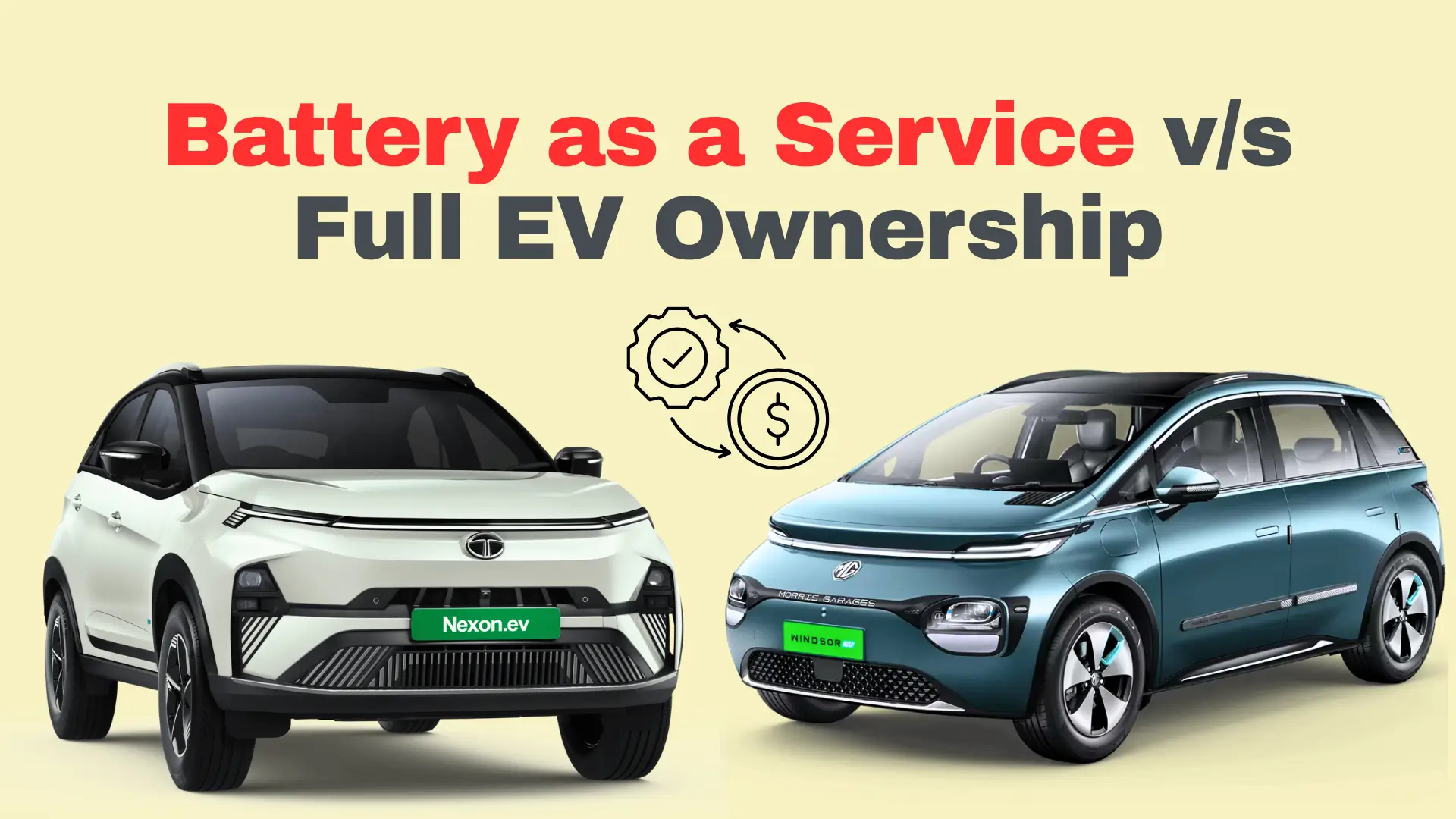
You go to an MG or Tata showroom, ask for the price of a car like the Windsor EV, and the salesperson gives you two different prices for the same car. One is around ₹9.99 lakh, and the other is about ₹13.5 lakh. Same car, same colour, same features. This is where most buyers get confused.
Then they start explaining something called Battery as a Service (BaaS), and honestly, for many people, it becomes difficult to understand.
So, in this article, we will keep things simple and clear.
We will break down the actual cost of BaaS over 5 years, based on different usage levels, and compare it with buying the full car.
No marketing talk, no sales pitch, just a clear comparison to help you decide easily.
First, What Exactly Is BaaS?
Battery-as-a-Service is a battery rental program that allows you to pay for the entire car, its body, the features, everything, but what isn’t included in the asking price is the cost of the battery. Instead, you pay per kilometre you drive.
Think of it as a SIM card plan for your car’s battery, prepaid, usage-based, and billed monthly.
MG introduced the BaaS ownership plan in India with the Windsor EV, which was launched in September 2024. A larger 52.9kWh pack was added to the line-up in May 2025. Since then, Tata, Maruti, and others have followed.
Today, BaaS is a real, growing part of how people in India buy electric cars.
Currently, three mass-market EV manufacturers, MG, Maruti, and Tata, are offering battery subscription plans in India.
The MG Windsor EV – India’s First and Most Popular BaaS Car
The Windsor is the best real-world example to use for this comparison because it was the first, it’s the most popular, and its data is the most extensive.
Here’s what the two buying options look like:
| BaaS Option | Full Ownership | |
|---|---|---|
| Ex-Showroom Price | ₹9.99 lakh | ₹13.5 lakh (approx) |
| Battery Pack | Rented, ₹3.9/km | Included, yours forever |
| Upfront Saving | ₹3.5 lakh less | Higher upfront |
| Battery Warranty | Lifetime (with BaaS) | As per the variant |
| Minimum Monthly Commitment | 1,500 km = ₹5,850/month | None |
MG says customers will have to recharge the battery pack for a minimum of 1,500 km every month, which costs ₹5,250 (₹3.5 × 1,500 km).
This is irrespective of the distance you drive; even if you drive 500 km or 1,000 km in a month, you still pay for 1,500 km minimum.
That last point is important. I’ll come back to it.
The Real Cost Breakdown, 5 Years, Three Conditions
I calculated the total cost of ownership for both options across three usage profiles: low mileage (1,000 km/month), moderate (1,500 km/month), and high (2,500 km/month).
I’ve used ₹1/km as a standard charging cost estimate for home charging on the Windsor.
Condition 1, Low Usage: 1,000 km/month (12,000 km/year)
| Cost Head | BaaS | Full Ownership |
|---|---|---|
| Car Purchase | ₹9,99,000 | ₹13,50,000 |
| Battery Rental (5 yrs × 18,000 km min/yr) | ₹3,51,000* | ₹0 |
| Charging Cost (5 yrs) | ₹60,000 | ₹60,000 |
| Total 5-Year Cost | ₹14,10,000 | ₹14,10,000 |
Minimum 1,500 km/month applies; even though you’re driving only 1,000 km, you pay for 1,500 km.
Verdict: At low usage, BaaS is actually more expensive in running cost because of the minimum km rule, you’re paying for kilometres you’re not driving. Full ownership wins here.
| Cost Head | BaaS | Full Ownership |
|---|---|---|
| Car Purchase | ₹9,99,000 | ₹13,50,000 |
| Battery Rental (5 yrs × 90,000 km) | ₹3,51,000 | ₹0 |
| Charging Cost (5 yrs) | ₹90,000 | ₹90,000 |
| Total 5-Year Cost | ₹14,40,000 | ₹14,40,000 |
Verdict: Near-perfect break-even at 1,500 km/month over 5 years. Neither option wins outright; this is exactly the usage level MG has designed BaaS around.
Condition 3, High Usage: 2,500 km/month (30,000 km/year)
| Cost Head | BaaS | Full Ownership |
|---|---|---|
| Car Purchase | ₹9,99,000 | ₹13,50,000 |
| Battery Rental (5 yrs × 1,50,000 km) | ₹5,85,000 | ₹0 |
| Charging Cost (5 yrs) | ₹1,50,000 | ₹1,50,000 |
| Total 5-Year Cost | ₹17,34,000 | ₹15,00,000 |
Verdict: Full ownership wins by over ₹2.3 lakh at high mileage. If you’re clocking 2,500+ km a month, as cab drivers, business owners, and intercity commuters, BaaS will cost you significantly more over time.
What Real Owners Are Saying
Before you think this is just spreadsheet analysis, I went and read through actual owner reviews and community discussions on Team-BHP and CarDekho.
Here’s what real Windsor buyers are saying:
One Team-BHP reviewer who opted for BaaS wrote: “Luxury and comfort, amazing car. The BaaS proposal from MG was also unique, but now, after 8 months, I realise I should have just bought the full car. My usage is barely 900 km a month, but I’m paying the 1,500 km minimum every month anyway.”
On the other side, a fleet operator on a popular Indian EV forum noted that for his team of airport cabs doing 3,000+ km a month each, BaaS made zero sense, and he went full ownership across all six Windsors he bought.
A reviewer who drove the Windsor for 10 days described the BaaS model as “kind of like a prepaid SIM plan for your battery”, flexible for moderate users, but something you need to plan around carefully depending on your driving habits.
The pattern is clear: buyers who understood BaaS before buying are mostly happy. Buyers who didn’t read the fine print, specifically the minimum km rule, felt caught out later.
The Tata Punch EV BaaS Even More Accessible
The Tata Punch EV costs about ₹6.49 lakh with BaaS, compared to ₹9.69 lakh without it.
That’s a ₹3.2 lakh upfront saving. The battery rental fee for the Punch EV is ₹2.6 per km, the most affordable battery subscription fee for any car in India.
At 2.6/km, the Punch EV BaaS maths look like this for a 1,500 km/month user:
| Punch EV BaaS | Punch EV Full Ownership | |
|---|---|---|
| Car Price | ₹6,49,000 | ₹9,69,000 |
| Battery Rental (5 yrs × 90,000 km) | ₹2,34,000 | ₹0 |
| Charging (5 yrs) | ₹90,000 | ₹90,000 |
| Total 5-Year Cost | ₹9,73,000 | ₹10,59,000 |
Here, BaaS actually wins over 5 years, the lower ₹2.6/km rate combined with the big ₹3.2 lakh upfront saving means you come out ahead even at moderate usage.
This is Tata’s competitive edge over MG’s BaaS pricing.
Who Should Actually Choose BaaS?
After all the numbers, here’s my honest take:
BaaS makes sense if you:
- Drive between 1,200 and 2,000 km per month consistently
- Want a lower EMI and can manage the battery rental as a separate monthly cost
- Are you a first-time EV buyer who wants a lower entry price
- Don’t have ₹13–14 lakh liquid cash right now, but can manage ₹5,000–6,000/month running cost
Full Ownership makes sense if you:
- Drive less than 1,000 km a month (the minimum rule will hurt you)
- Drive more than 2,500 km a month (the per-km cost piles up fast)
- Plan to resell the car in 3–4 years (full ownership has better resale clarity)
- Are you buying for a fleet or business where cost-per-km predictability matters
One More Thing Nobody Talks About – Most Important: Its Resale Value
MG Motor India offers a lifetime battery warranty to the first buyer under the BaaS model.
It also allows you to transfer the subscription if you sell the car.
On paper, this sounds like a strong benefit.
The new owner continues the same BaaS plan and also gets the lifetime battery warranty.
But there’s a catch.
The second buyer also takes on the per-kilometre battery rental cost. So along with the car, they inherit an ongoing payment commitment.
In a market like India, where EV resale is still developing, and buyers are already cautious, this can make things a bit complicated. Many used-car buyers prefer a simple, one-time ownership without any recurring obligations. Read here Understanding the Resale Value of Electric Vehicles after 5 or 10 Years.
Some analysts have also raised concerns about this model. Since the battery cost is delayed and tied to usage, it could impact resale value and buyer preference in the long run.
Many customers may still lean towards full ownership for peace of mind.
This becomes more important as the used EV market in India grows over the next 2–3 years and buyers become more aware and selective.
Final Thoughts
BaaS is not a dealership trick meant to confuse buyers. It is a genuine financial option. For some people, it works very well.
For others, it can end up costing more over time.
The difference comes down to understanding your own usage before making a decision.
For example, a friend of mine drives around 800 km per month. I suggested he go for full ownership instead of BaaS. He followed that advice. A few months later, he said he was happy with the decision, his EMI is fixed, there are no extra running-based charges, and it feels simpler to manage.
That’s what this decision really depends on.
It’s not about EV vs petrol, or choosing sides between BaaS and ownership. It’s about your numbers—how many kilometres you actually drive every month—and whether the overall cost works in your favour.
Run that number first. Everything else follows.
Disclaimer: All cost calculations are estimates based on publicly available pricing. Actual costs may vary based on the finance partner, usage, and regional electricity tariffs. Consult your nearest dealership for exact on-road pricing.
FAQs